
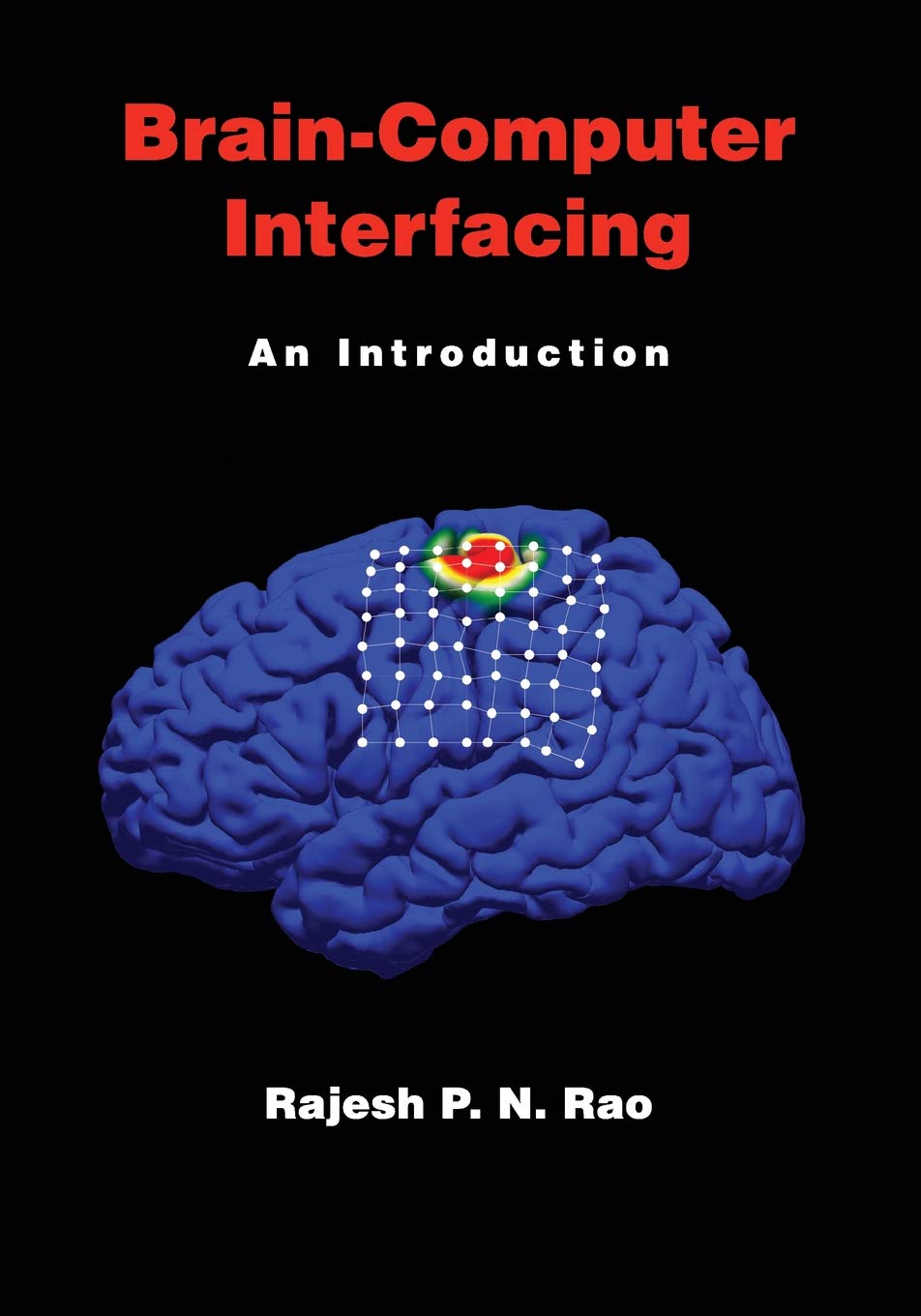


Brain-Computer Interfacing: An Introduction
OVERVIEW
(as of Oct 16, 2025 00:38:54 UTC - Details)

The idea of interfacing minds with machines has long captured the human imagination. Recent advances in neuroscience and engineering are making this a reality, opening the door to restoring and potentially augmenting human physical and mental capabilities. Medical applications such as cochlear implants for the deaf and deep brain stimulation for Parkinson’s disease are becoming increasingly commonplace. Brain- computer interfaces (BCIs) (also known as brain- machine interfaces or BMIs) are now being explored in applications as diverse as security, lie detection, alertness monitoring, telepresence, gaming, education, art, and human augmentation. This introduction to the field is designed as a textbook for upper- level undergraduate and first year graduate courses in neural engineering or brain- computer interfacing for students from a wide range of disciplines. It can also be used for self- study and as a reference by neuroscientists, computer scientists, engineers, and medical practitioners. Key features include: Essential background in neuroscience, brain recording and stimulation technologies, signal processing, and machine learning. Detailed description of the major types of BCIs in animals and humans, including invasive, semi-invasive, noninvasive, stimulating, and bidirectional BCIsIn-depth discussion of BCI applications and BCI ethicsQuestions and exercises in each chapterSupporting Web site with annotated list of book- related links
Publisher : Cambridge University Press
Publication date : June 13, 2019
Edition : Annotated
Language : English
Print length : 335 pages
ISBN-10 : 1108708013
ISBN-13 : 978-1108708012
Item Weight : 1.3 pounds
Dimensions : 7 x 0.76 x 10 inches
Best Sellers Rank: #1,368,500 in Books (See Top 100 in Books) #153 in Biomedical Engineering #297 in Physical Anthropology (Books) #539 in Natural Language Processing (Books)
Customer Reviews: 4.5 4.5 out of 5 stars 39 ratings var dpAcrHasRegisteredArcLinkClickAction; P.when('A', 'ready').execute(function(A) { if (dpAcrHasRegisteredArcLinkClickAction !== true) { dpAcrHasRegisteredArcLinkClickAction = true; A.declarative( 'acrLink-click-metrics', 'click', { "allowLinkDefault": true }, function (event) { if (window.ue) { ue.count("acrLinkClickCount", (ue.count("acrLinkClickCount") || 0) + 1); } } ); } }); P.when('A', 'cf').execute(function(A) { A.declarative('acrStarsLink-click-metrics', 'click', { "allowLinkDefault" : true }, function(event){ if(window.ue) { ue.count("acrStarsLinkWithPopoverClickCount", (ue.count("acrStarsLinkWithPopoverClickCount") || 0) + 1); } }); });
Customers say
Customers find the book's content great and appreciate its introductory material, with one customer noting it provides a comprehensive overview of signal processing and machine learning. However, the readability receives mixed feedback, with several customers mentioning that the equations are difficult to read.
(as of Oct 16, 2025 00:38:54 UTC - Details)
RELATED PRODUCTS
REVIEWS
Reviews
There are no reviews yet.